
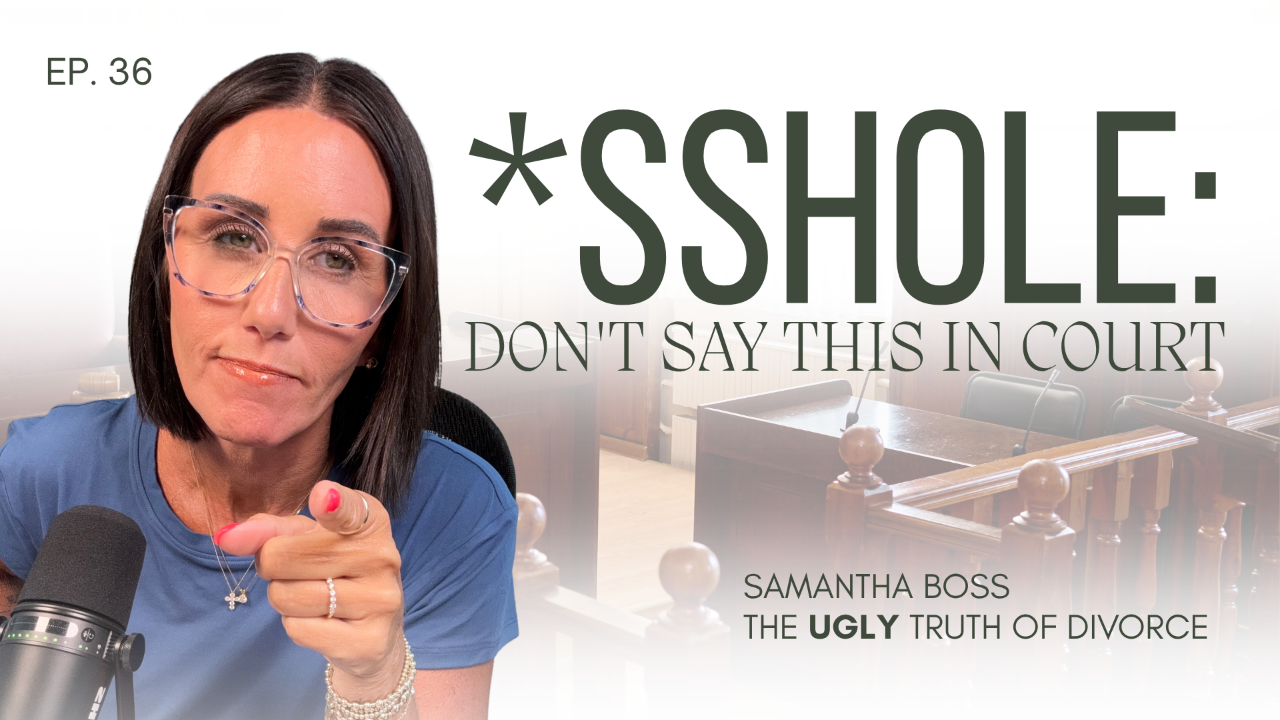
Stop Calling Them High Conflict, Start Proving It
Jun 09, 2026You stood up. You said "my ex is a narcissist." And every person in that courtroom over the age of 40 silently rolled their damn eyes at you.
Welcome to the dumbest move in custody court. Yet half of you are still going to do it next month.
Somewhere along the line, you decided that the buzzwords you learned from a TikTok therapist were going to seal the deal. Narcissist. High conflict. Toxic. Manipulator. Crazy. Asshole. You've been rehearsing it for weeks. You think the judge is finally going to understand. The judge already understood 30 seconds in. They just don't agree with you. And now they're waiting for something they can actually write down. You're not going to give it to them. Because you spent the last three years labeling instead of documenting.
This week I'm taking a flamethrower to everything you've been told about how to win in court. You're not special. Your story isn't special. Your ex isn't even that unique. What separates the winners is who walks in with receipts and who walks in with adjectives.
I'm laying out the exact data-driven reframes for every common complaint. "He's always late" becomes "18 of 30 exchanges, late 10 to 45 minutes." "She doesn't communicate" becomes "14 of 22 messages about the kids, ignored." "He talks badly about me" becomes "27 messages in three weeks containing insults, all highlighted." And the brutal courtroom move I'd pull as your attorney with that list. I'd make your ex stand on the stand and read every single insult out loud. Their words. Their face. Their voice. Their loss.
I'm also coming for the attorney who's been pocketing your retainer without ever asking you for a spreadsheet. The one who lets you treat the stand like a therapy couch. If your attorney hasn't asked you for documentation, you've got a Larry. And Larry is going to lose you this case while charging you for the privilege.
The brutal truth nobody wants to say out loud. Storytelling doesn't win custody. Spreadsheets do. Adjectives don't win custody. Numbers do. Pain doesn't win custody. Patterns do. And if you walked out of your last hearing with nothing to show for it, your strategy was the problem. Not the judge. Not your ex. You.
If you've got a hearing on the calendar, drop everything and listen to this. Next time you walk in there, walk in with the spreadsheet.
Here’s What You Can Actually Take Away:
- Stop Describing, Start Documenting - The judge doesn't care what you think your ex is, they care what you can prove your ex does.
- Opinions Get You Labeled Too - When you stand up and call your ex a narcissist or an asshole, the judge silently labels YOU as the dramatic one in the room.
- Reframe Everything As Data - "Always late" becomes "18 of 30 exchanges late by 10 to 45 minutes" and now the judge has something to write down.
- Patterns Beat Incidents Every Time - Judges dismiss single events as bad days and downplay them; consistent patterns over months are impossible to ignore.
- Your Story Is Not Evidence - Court is for proof, therapy is for processing, and if you confuse the two you'll lose both rooms.
- Have Them Read It Out Loud - When your ex's own insults are highlighted on paper, the most damaging move is making them say each one in their own voice.
- Build Your Case Like A Paralegal - Hiring an attorney does not mean you stop working; documentation is YOUR job and Larry's just there to present it.
- The Judge Hears This All Day - Standing out isn't about being louder, it's about being the only parent in the room with receipts.
The Truth Bombs
- "Stop saying it and start showing it."
- "Court is not where you process your pain. It's where you present your proof."
- "You're not up there to describe your ex. You're up there to demonstrate their behaviors over time."
- "Anybody can be an asshole and be a parent. The question is can they co-parent."
- "I don't need to label my ex. I'll give the judge enough evidence to slap that label on themselves."
- "Your opinion is not evidence. Your data is."
- "Patterns win in court. Single incidents get downplayed as 'a human moment.' Bring receipts."
- "If it's not measurable, I don't know why you're bringing it."
PURCHASE your own custom plan here:
About to sign something you don't understand? Walking into mediation empty-handed? I can help.
Custom Parenting Plan — I'll write your plan. Built for your kids, your schedule, your high-conflict ex. Not a template. A plan that protects your time for the next 18 years.
The Parenting Plan Masterclass — Learn what strong parenting plans actually look like before you sign anything. I'll walk you through decision making, parenting time, holidays, communication boundaries, and how to prepare for mediation so you know exactly what to ask for and what garbage language to avoid.
Follow Samantha Boss:
We'd Love to Hear Your Stories!
Have a story or question you want addressed?
This podcast exists because way too many parents are slogging through divorce quietly and thinking they are the only ones dealing with this mess. You can share your story, ask real questions, or send in topics you want broken down without the fluff. Stories can be shared anonymously, and no, this is not legal advice, but honest conversations are where clarity actually starts.
Samantha Boss: This is a mistake I see a lot of clients make who, I'm just gonna say it, don't have the best attorney representing them. A lot of clients walk into court thinking they're gonna use the words "high conflict" and label their ex in an attempt to beat them in court. I can't disagree with this strategy more. I think it's crazy. I think it's dangerous. But walking into court and saying your ex is high conflict is one of the fastest ways to lose credibility. Because the court isn't here to hear your opinion. They're here to see the evidence.
That's what we're gonna talk about today. Some of the biggest mistakes.
What You Say To Your Lawyer vs What You Say In Court
Right from the beginning, I have clients who will talk to their attorneys like they would a friend or anybody. So when you're talking to your attorney and you're like, "Oh, my ex is an asshole. She's a crazy bitch. He's a narcissist. He's impossible to deal with." Those are things you say to your attorney. But you do not say those in court because those are all opinion pieces.
You may think they're an asshole, but maybe they're an upstanding citizen who just doesn't like you and so the two of you don't get along. And for you to say they're a narcissist, well, you're not a doctor. So you really aren't able to say those things. To say it's impossible to work with this person, but yet they can bring in six witnesses who say they're great at their job and they work well with others? You just lost credibility.
To say stuff like, "Well, she never communicates," that's very broad and basic. But what is she not communicating about? All of these fail because they're emotional. They're not factual. It puts the level of conflict just as much on you as it does on them because you're just there labeling them.
And the judge hears this shit all day long, to be honest. So it doesn't stand out. It just becomes another person on the stand labeling their ex without any proof or any pattern showing.
Stop Describing. Start Demonstrating.
This is the shift that needs to happen. You're not up there to describe your ex. You're up there to demonstrate their behaviors over time. So stop saying it and start showing it.
That's how your attorney should be coaching you. If your attorney is not coaching you on how to speak in court on the stand, I'm gonna give you an episode for that. It's coming up.
The tactical thing to do is reframe what you're complaining about, or the thing you want to show, or the label you want to give. We have to reframe it into tangible, measurable things. Because when judges see data like, "Wow, those numbers are staggering. Those numbers are atrocious," they can take their own label by hearing the data behind the statement.
"He's Always Late" Becomes Data
Here's where people go wrong. They'll make a statement like, "He's always late." You get on the stand and say, "Always late, never on time, can't account for him, always 15 minutes here and there." Okay. Well, that sounds a lot like bitching. While it may be true, have you tracked it? Are you able to prove it?
Instead, I would say something like this. This is what I recommend to all my clients. Make sure it's tangible and measurable.
"Out of the past 30 exchanges before this court date, he was late 18 times, ranging anywhere from 10 minutes to 45 minutes. Out of those 18 times late, six of them were over 45 minutes."
This isn't me getting on the stand saying "He's always fucking late." It's "In 30 exchanges, over half of them, 18 of them, he was late." Those are numbers a judge can write down.
Because if you're new here, judges hear your case but then don't determine the findings until maybe 30, 60, sometimes 90 days later. So if they just write down "mother complained he was late," and then they read it 60 days from now? They're gonna be like, "Oh wow, it's not that big a deal. Maybe he's five minutes late." But if you give them data supporting that, that's easier to write down or show as evidence in a spreadsheet.
"She Doesn't Communicate" Becomes A Pattern
Next one. "She doesn't communicate." Well, that sounds like a you problem. Judges hear this all the time.
Instead, say something like, "Out of 22 messages regarding the children, 14 received no responses." What? 14 times they did not respond about the children, but they're sitting over here saying they want joint, they want 50/50, they want full custody. But they can't communicate.
The 27 Insults Move
Another example of where parents get it wrong and attorneys don't coach you right. "He talks badly about me all the time." My first question as a judge would be, "How do you know that?"
Instead, you say, "In a three-week period, there have been 27 messages containing insults or profanity, and I have them here highlighted."
What? In just three weeks, he's called you 27 bad names and they're all highlighted? And here's a little side note. If I were your attorney, when your ex is on the stand, I would have them read those out loud. Every. Single. One. In their own voice.
"She Doesn't Show Up" And "He Doesn't Pay"
"She doesn't show up." Was it one time? Was it seven times? Doesn't show up for the kids? Never comes to anything? That's your opinion. Out of how many things?
Instead: "They've missed five school events, three medical appointments, and two scheduled visitations just in the past 60 days." Data behind the accusation.
The last one. "He doesn't pay." Break it down. What is he not paying for? Is he court ordered to? "Currently $2,400 behind in copays and school-related expenses just in the last four months."
Again, I don't need to put labels on my ex. I want to give evidence that makes the judge slap that label on themselves. Wow. Doesn't pay. Doesn't show up. Always not communicating. Late to a visit. Those are tangible. Plus I can prove all of it with documentation, which becomes evidence in my case.
Why Patterns Win
Why do patterns win in court? It's simple. Judges look for consistency, not isolated incidents.
This is where a lot of clients say, "Yeah, Sam, but three years ago this happened. Six months ago this happened." Okay. Have they done it again? Because here's how a judge looks at that.
A judge hears this shit every single day. Not that they should categorize your case against another case, but instinctively they might say, "Oh gosh, this case is so much easier than the one I just got out of this morning." So you have to show that your ex isn't just having a bad human moment. That this is a repeated, bad pattern of behavior. And that the pattern shows the decision that this is who they want to be.
They want to be somebody who's always late. They want to be somebody who doesn't show up. They want to be somebody who doesn't pay. Because I've shown the pattern of their behavior.
The One-Incident Trap
I have to repeat this. So many of you think this one incident that happened, and I don't care how bad it is, you think this one incident is going to make your case. From years of experience: don't put all your eggs in one basket.
Because if I was coaching the other side of that, I would say, "I had a human moment. I lost my mind. You're right. I overreacted. I was getting ready to lose my whole family and I lost my mind. I talked out of turn. I did X, Y, and Z." They will downplay it as a one-time event.
But when you can show a pattern, that speaks differently.
Emotional Discipline And Audience
The emotional discipline piece. You have to separate your audience. Who's listening to you?
You have to stop venting to the court system. That audience is for facts. Your therapist is for venting. Even your attorney if you can afford to. But you are not getting on the stand and venting about how horrible they were in their marriage. Because that divorce is about the future and you have to prove that you're fit.
Stop trying to get the court to understand emotionally what happened. Start getting the court to see what physically is happening. What does the data show?
Start thinking about building your case, not just telling a story. Some of you are great storytellers. I'm a good storyteller. But can you imagine how slam dunk my case would've been if I had been a great storyteller AND showed the data to prove the patterns?
Instead, I got up and said, "Oh, he's a horrible person. Oh, she's this and she's that. And this one time she..." But I had data and evidence that was measurable to back that up.
Court is not where you process your pain. It's where you present your proof. If it's not measurable, if it's not data worthy, I don't know why you're bringing it.
What To Bring To Court
You want to walk in and say, "Look, this is what I'm gonna show you. I've tracked all the dates and times for exchanges. I have screenshots of the piss poor communication. I've logged all the missed events, late payments, no responses."
Keep it factual. Take the emotion out of it. Ask yourself: does this make sense to where if a stranger was reading it, they would come to the conclusion that this person has a pattern of bad behavior, of bad co-parenting, of being just a bad human?
Whatever you're trying to prove, does your data support that?
Show the court there is a pattern. And then let the pattern speak for itself.
If I tell a judge somebody's been late 18 out of the last 30 times, statistically I'm showing more than half the times they're late. The judge can't help but go, "This person has a problem with time. They are not respecting the wishes of the court to comply with a set schedule. That's a problem."
I don't have to say those words. The data will show those words.
When I go up there leading with "they're high conflict, they're a narcissist," the judge is labeling ME right away. That I'm stepping out of my lane and putting labels on somebody I'm not trained or certified to give. I don't want that mark against me. I'm just gonna show the data and let it speak for itself.
Do You Have A Larry?
If your attorney is not coaching you on this strategy, especially with your own evidence, I beg the question. Do you have a Larry?
Because they should be taking all of this evidence and using it in your case in an organized manner to show the pattern of behavior your ex is displaying. High conflict without saying those words.
Your attorney should be coaching you on how to document. Should be showing you how to document.
This is stuff you need to learn because if you've learned anything from me, you've got to take care of your own case. Just because you hired an attorney doesn't mean you're done. You've got to work full time as your own paralegal, documenting things worth proving.
Somebody's an asshole, they're an asshole. But if somebody's always late, misusing time, not paying back, not communicating about the children? That's a different case. Anybody can be an asshole and be a parent. But the question is, can they co-parent? I've got to show the pattern that they're not, and that's why I'm asking the court for X, Y, and Z.
Work with your attorney. If not, my team is here to help. But you have to start understanding how to perform better in court. And it's not walking in, telling a story, and slapping a label on your ex. It's showing patterns. It's showing behaviors. That's how you'll win.
A Team Dklutr Production
